WCAG vs WCAG 3.0 - What Changes and When to Plan
The development of digital products has created new requirements for digital accessibility. Teams now develop mobile applications and complete web development projects and create PDF documents and digital voice systems and new technologies which include AR/VR.
The current accessibility compliance standard requires organizations to use WCAG 2.2. The development of WCAG 3.0 will establish new accessibility guidelines which will guide organizations in their accessibility practices. The document presents information about upcoming accessibility standards although it has not reached its final form yet.
This guide explains the key differences between WCAG 2.2 and WCAG 3.0, what is changing, what still matters from WCAG 2.x, and how your team can prepare early without moving away from today’s requirements.
Organizations need to use WCAG 2.2 as the current standard while they start creating their future WCAG 3.0 compliance plans.
WCAG 3.0 Status as of April 2026
As of April 2026, the current official W3C Recommendation used for accessibility audits, remediation, and most compliance planning is WCAG 2.2. WCAG 3.0 is still a Working Draft and is not yet a compliance standard.
The Working Draft of WCAG 3.0 remains incomplete because it has not yet achieved status as a final standard. The most recent WCAG 3.0 Working Draft was released on March 3 2026 but it will undergo revisions until it achieves official recommendation status.
The final release date of WCAG 3.0 remains unconfirmed. The WCAG 3.0 standard should be used as a planning tool for future developments instead of being treated as a requirement for legal compliance.
Teams should use WCAG 2.2 until they complete their preparations for upcoming changes which will come with WCAG 3.0 implementation.
Quick Answer: WCAG 2.2 Is for Compliance, WCAG 3.0 Is for Future Planning
- You should use WCAG 2.2 for your accessibility audits and your accessibility fixes and your compliance planning.
- Organizations should use WCAG 3.0 for their future planning needs because it exists as a Working Draft instead of a finished standard.
- The most significant changes in WCAG 3.0 bring new rules for measuring accessibility and conducting tests and achieving better inclusive design.
- Organizations should start improving accessibility right now instead of waiting for WCAG 3.0 to release. Organizations should begin their work with WCAG 2.2 and then transition to WCAG 3.0 in the future.
What is WCAG 3.0 - Overview of The New Standard
The W3C Web Accessibility Initiative (WAI) is developing WCAG 3.0 as the upcoming major version of accessibility guidelines. The framework enables users to implement accessibility standards throughout all contemporary digital products instead of being restricted to traditional websites.
The latest draft of WCAG 3.0 exists as a Working Draft which will remain active until its next version release on March 3 2026. The document has not reached final status as a W3C Recommendation because the W3C continues to update its contents until official publication. (W3C)
The transition from WCAG 2.x to WCAG 3.0 will take place eventually, yet both standards will remain in use for multiple decades. Organizations need to adhere to WCAG 2.2 standards for compliance but they should monitor WCAG 3.0 developments to inform their upcoming requirements.
A Broader Scope for Modern Digital Experiences
The designers of WCAG 2.x developed the standard to address web content whereas WCAG 3.0 aims to create standards for all digital content. The team wants to improve accessibility guidance so that it better serves users who interact with technology at present and in upcoming years.
The accessibility framework of WCAG 3.0 will provide support to:
- Websites
- Web applications
- Mobile apps
- PDFs and digital documents
- eBooks
- Software interfaces
- Interactive media
- XR / AR / VR experiences
- Voice interfaces
- Conversational UI
The extended range of WCAG 3.0 requirements demonstrates its importance because it enables organizations to create accessible plans which cover all digital content not just online platforms.
WCAG 3.0 Release Date: When Will It Be Final?
The WCAG 3.0 standard does not have an established final release date at this time. The WCAG 3.0 standard exists as a Working Draft because its development continues up to the date of April 27 2026.
Teams need to track official W3C updates because the current draft will undergo changes before the final publication of WCAG 3.0 which should not be regarded as a permanent standard.
Organizations can start their planning process while WCAG 2.2 serves as the active standard for conducting accessibility audits and implementing website accessibility improvements.
WCAG 2.2 vs WCAG 3.0: Key Differences
Understanding how WCAG 3.0 differs from WCAG 2.2 helps organizations decide what to follow today and what to prepare for next.
| Dimension | WCAG 2.2 | WCAG 3.0 |
| Current status | Official W3C Recommendation | Working Draft |
| Best use today | Compliance, audits, and remediation | Future planning and accessibility maturity |
| Compliance model | Pass/fail success criteria | Outcome-based and graded model |
| Conformance levels | A, AA, AAA | Proposed Bronze, Silver, Gold |
| Scope | Mainly web content and web-based interfaces | Broader digital experiences, including apps, documents, interactive media, and emerging technologies |
| Testing approach | Technical checklist-based testing | Outcome and usability-focused evaluation |
| Disability coverage | Strong coverage, but limited in some cognitive areas | Broader inclusion of cognitive, learning, and situational needs |
| Legal relevance | Commonly referenced in accessibility policies and laws | Not legally required yet |
| Business action | Fix current accessibility gaps using WCAG 2.2 | Prepare systems, teams, and testing models for future standards |
WCAG 2.2 A/AA/AAA vs WCAG 3.0 Bronze/Silver/Gold
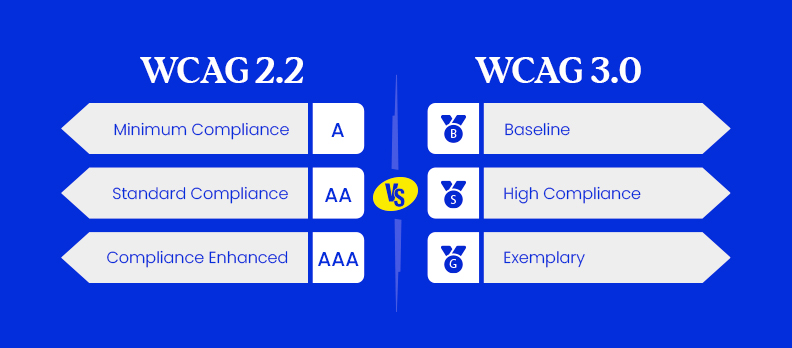
The main proposed change for WCAG 3.0 establishes a new way to assess compliance with the guidelines.
The WCAG 2.x standard establishes three accessibility standards which organizations must follow to achieve compliance.
- Level A - Basic accessibility requirements
- Level AA - Organizations use this level as their main accessibility goal which also appears in most legal requirements
- Level AAA - Advanced accessibility features present challenges for organizations to accomplish full implementation
WCAG 3.0 introduces a new structure which establishes Bronze, Silver and Gold levels as its main accessibility framework. The system assesses performance through its success criteria which enable organizations to assess their accessibility development throughout time.
- Bronze: Proposed foundational accessibility outcomes
- Silver: Proposed stronger accessibility performance across broader measures
- Gold: Proposed highest proposed maturity level for accessibility outcomes.
The proposed model matters because it may support gradual, measurable accessibility improvement, rather than treating accessibility only as a binary pass/fail exercise.
What Remains Relevant From WCAG 2.x?
The WCAG 3.0 standard introduces major changes to accessibility guidelines, yet it still recognizes WCAG 2.x as a valid standard. The essential accessibility elements from the past continue to hold their value, so teams need to adopt WCAG 2.2 as their operational standard until they develop new standards for upcoming releases.
POUR Principles Still Matter
Both WCAG 2.2 and WCAG 3.0 continue to build around the four core POUR principles:
- Perceivable: Content should be available in ways users can perceive, whether visually, audibly, or through assistive technologies.
- Operable: Users should be able to navigate and interact with content, including using keyboards or assistive tools.
- Understandable: Content and functionality should be clear, predictable, and easy to use.
- Robust: Content should work across devices, browsers, and assistive technologies.
These principles remain the foundation of accessibility planning.
WCAG 2.2 Practices You Should Still Follow
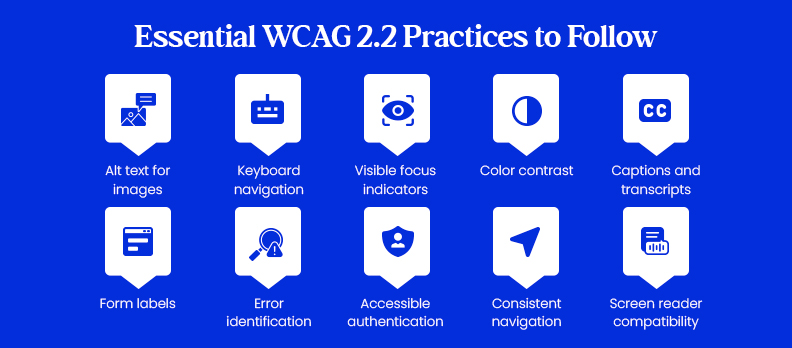
The following accessibility requirements from WCAG 2.2, which contain practical elements, remain essential today:
- Alt text for images
- Keyboard navigation
- Visible focus indicators
- Color contrast
- Captions and transcripts
- Form labels
- Error identification
- Accessible authentication
- Consistent navigation
- Screen reader compatibility
The digital accessibility practices from this report make online content accessible to users currently, while they will continue to do so when WCAG 3.0 enters its next phase.
Why WCAG 3.0 Matters
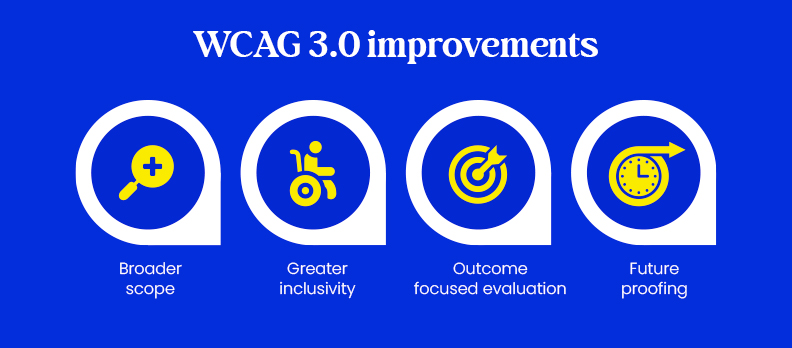
WCAG 3.0 matters because it reflects how digital experiences and accessibility needs are changing. Businesses are no longer managing only websites.
They also need to think about apps, documents, software, interactive tools, and emerging interfaces.
Broader Scope
WCAG 3.0 is designed to better support modern digital formats, including web apps, mobile apps, documents, software, interactive media, and emerging technologies like AR/VR.
Greater Inclusivity
WCAG 3.0 aims to support a wider range of users, with more attention to cognitive, learning, and situational disabilities, along with visual, auditory, and motor needs.
Outcome-Focused Evaluation
Instead of focusing only on technical checks, WCAG 3.0 moves toward evaluating real-world usability. This can help teams improve accessibility gradually instead of treating it only as pass or fail.
Future-Proofing
WCAG 3.0 helps businesses prepare for future accessibility expectations as technologies, platforms, and user needs continue to evolve.
Is WCAG 3.0 Legally Required in 2026?
No, WCAG 3.0 is not legally required in 2026. It is still a Working Draft, so organizations should not treat it as a final compliance standard.
For current accessibility compliance, WCAG 2.2 remains the safer benchmark. Some laws, policies, and procurement requirements may still reference WCAG 2.1, so teams should always check which version applies to their region or industry.
Organizations should also avoid claiming full WCAG 3.0 compliance while the standard is still under development.
Who Should Start Preparing for WCAG 3.0?
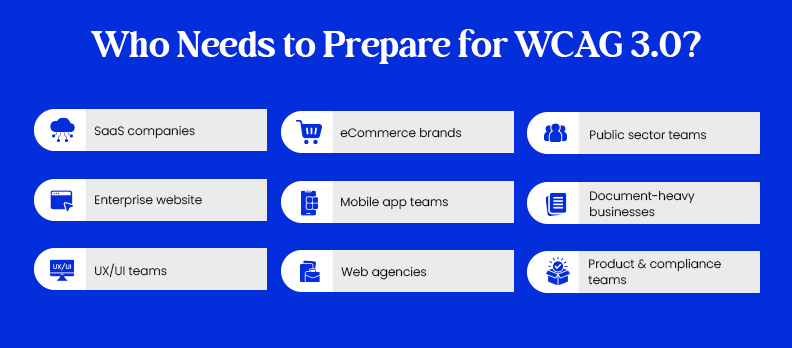
WCAG 3.0 planning is useful for many organizations managing modern digital experiences, including:
- SaaS companies: Prepare accessible product experiences across complex interfaces.
- eCommerce websites: Improve accessibility across shopping, checkout, and account journeys.
- Public sector organizations: Support evolving accessibility expectations and compliance needs.
- Enterprise websites: Strengthen accessibility across large, multi-layered digital ecosystems.
- Mobile app teams: Plan for accessibility beyond traditional web experiences.
- PDF or document-heavy businesses: Improve accessibility across downloadable and structured content.
- UX/UI teams: Start aligning design systems with broader accessibility thinking.
- Web development agencies: Help clients prepare for evolving standards and expectations.
- Product and compliance teams: Support long-term accessibility governance and readiness.
How to Prepare for WCAG 3.0 Without Ignoring WCAG 2.2
Teams should prepare for WCAG 3.0 gradually while continuing to follow WCAG 2.2 today.
- Audit your current website against WCAG 2.2: Understand your current accessibility gaps before planning future improvements.
- Fix high-priority accessibility issues first: Focus on barriers that most affect user access and compliance risk.
- Review mobile apps, PDFs, forms, and key user journeys: Expand accessibility checks beyond standard web pages.
- Add accessibility checks into design and development workflows: Make accessibility part of daily production, not a final review.
- Train content, UX, QA, and development teams: Help every team understand their role in accessibility.
- Start usability testing with assistive technologies: Validate accessibility with real tools and user scenarios.
- Build an accessibility roadmap for WCAG 3.0 readiness: Prepare gradually while WCAG 2.2 remains your current compliance base.
WCAG 3.0 Migration Readiness Checklist
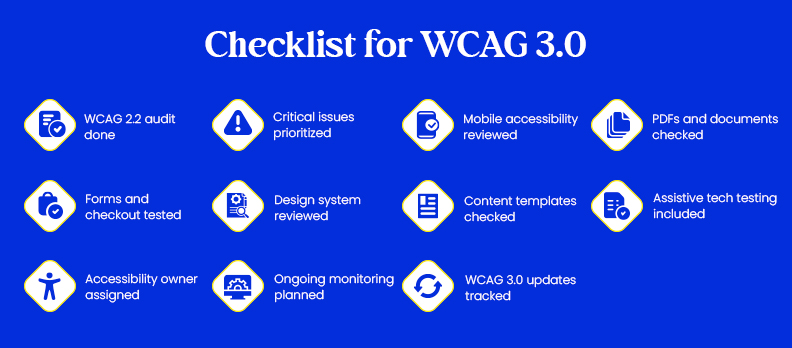
- WCAG 2.2 audit completed: Establish a clear baseline of your current accessibility status.
- Critical accessibility issues prioritized: Address the most impactful barriers first.
- Mobile app accessibility reviewed: Evaluate mobile experiences alongside websites.
- PDF and document accessibility checked: Ensure supporting documents meet accessibility expectations.
- Forms and checkout journeys tested: Review key user flows for accessibility barriers.
- Design system reviewed: Check reusable components for accessible patterns.
- Content templates checked: Make sure content structures support accessibility consistently.
- Assistive technology testing included: Validate experiences using screen readers and related tools.
- Internal accessibility owner assigned: Assign responsibility for accessibility oversight.
- Ongoing monitoring planned: Treat accessibility as continuous improvement, not a one-time project.
- WCAG 3.0 updates tracked: Monitor draft changes and evolving W3C guidance.
Conclusion & Call to Action
WCAG 3.0 is important because it shows where digital accessibility is heading, but it is not final yet. For now, WCAG 2.2 should remain your current compliance foundation for audits, fixes, and accessibility planning.
Organizations can use their existing WCAG 2.x work as a strong starting point and gradually prepare for the future direction of WCAG 3.0, including outcome-based evaluation and proposed Bronze, Silver, and Gold maturity levels.
A practical first step is to complete a free accessibility audit to understand the current state of your website, apps, documents, and key user journeys. You can also use a WCAG 3.0 migration readiness checklist to align your team, prioritize improvements, and prepare for future accessibility expectations.
FAQs
WCAG 2.2 is the current accessibility standard used for compliance. WCAG 3.0 is a future-focused Working Draft that introduces a broader scope, new scoring methodology, and outcome-based testing for digital accessibility.
No. As of April 27, 2026, WCAG 3.0 remains a Working Draft and is not yet a finalized standard.
There is no confirmed release date for WCAG 3.0. Organizations should monitor W3C updates while continuing to follow WCAG 2.2.
Audit your website now using WCAG 2.2. Waiting for WCAG 3.0 could delay important accessibility improvements and increase compliance risk.
No. Since WCAG 3.0 is not finalized, it is not legally required in 2026.
WCAG 3.0 is expected to eventually succeed WCAG 2.x, but both versions may coexist for many years.
Yes. WCAG 2.2 should remain your primary compliance framework for audits, remediation, and accessibility planning.
These are proposed WCAG 3.0 conformance levels intended to support gradual and continuous accessibility improvement.
Businesses should audit against WCAG 2.2, fix priority issues, review apps and documents, train teams, and build a WCAG 3.0 readiness roadmap.
Yes. WCAG 3.0 is being designed for a wider range of digital experiences, including mobile apps, PDFs, documents, and interactive interfaces.